


The biggest rotation number isn’t always the most useful. A rotatable faucet extender can offer extra reach and movement, but whether it helps depends on your faucet, sink layout, and everyday tasks. A “universal” fit claim alone may not tell you whether the connection matches your faucet.
A wider range of motion can help when rinsing the sink or directing water toward a particular spot. But the headline angle is only one detail. Consider the attachment method, clearance around the faucet, and how the outlet directs water. Changing the stream’s position can also change where splashes land.
This guide explains what to compare before buying, including fit, movement, water flow, and splash considerations. Use the practical checks to weigh product details against your sink routine and decide which features matter most for your setup.
Key Takeaways
- Compare movement, outlet options, connector details, and stated materials instead of relying on a headline rotation angle.
- A rotatable faucet extender changes where water reaches; it doesn’t automatically increase water pressure.
- Consider your basin depth, faucet position, and usual sink tasks to judge whether added reach will be useful.
- Record your faucet’s end shape and connection details before comparing them with an extender’s specifications.
- Explore Glocard’s 1080° Rotatable Faucet Extender - Splash-Free Kitchen & Bathroom Upgrade as an option for your sink routine.
What a Rotatable Faucet Extender Can Change at the Sink
A fixed faucet outlet can make some sink tasks awkward. A rotatable faucet extender is an attachment designed to redirect where water reaches within the sink. Depending on its design and position, it may let you aim the stream toward an area that’s harder to reach from the faucet alone.
That changes the stream’s direction or reach, not the water pressure in your plumbing. An extender doesn’t create extra pressure simply by moving or pivoting. The outlet design can affect how the stream looks and feels, so consider any stated flow or spray details rather than assuming the water will behave exactly as it does now.
The result depends on the setup: faucet position, basin shape, and the task at hand all matter. A faucet, also called a tap, comes in many forms and has varied uses. This faucet (tap) history and variations overview provides helpful background. For choosing an extender, focus on how it would direct water from your outlet into your sink.
What does a rotating faucet attachment help you do?
Movement may make it easier to rinse part of the basin or direct water toward an item you’re washing. For example, you might aim the stream closer to the center of a deep sink or shift it toward a spot that’s awkward to reach under a fixed outlet. The reachable area still depends on the attachment’s movement and how far the faucet sits over the basin.
An extender won’t necessarily reach every corner or prevent splashes. A shallow basin, high faucet, or narrow sink can change where water lands and how it rebounds. Start with the task you want to make easier, then picture the stream’s path from the faucet to that spot.
Does a bigger rotation number always mean better reach?
No. An advertised rotation angle describes the movement claimed for the attachment, not the useful water coverage you’ll get at every sink. A wide range of movement may still be less helpful if the faucet sits far to one side or the basin’s shape limits where the stream can land.
Rotation range describes how an attachment moves; practical coverage depends on where your faucet and basin place the water. Compare the outlet position with the basin’s depth and width. Then consider whether the movement described for the product would direct water toward the area you use for washing or rinsing.
For example, a stream that can turn toward the back of a basin may help if that’s where you rinse. It may matter less if you usually wash items directly beneath the faucet. Movement alone also doesn’t guarantee a comfortable stream or a splash-free sink. Base your comparison on the area you want to reach, not just the largest angle in a product title.
How to Compare Rotatable Faucet Extenders Beyond the Angle
A rotation figure or benefit phrase can make a product title sound like the whole story. For a useful comparison, separate details you can match to your faucet and routine from broad promotional language. Extenders with similar angle claims may differ in outlet options, connector dimensions, materials, or installation requirements.
Compare the product information with the needs of your own sink. Use a checklist and distinguish stated specifications from general benefit claims.
| Detail | What to compare | Why it matters |
|---|---|---|
| Movement | Stated rotation range and how the attachment moves | Helps you judge whether its movement suits the areas you want to reach. |
| Outlet or spray | Named outlet or spray options | Different descriptions may indicate different ways water exits the attachment. |
| Connector | Thread dimensions, adapter details, and installation requirements | Lets you compare the connection information with your faucet’s outlet. |
| Materials | Materials named in the product description | Provides a clearer basis for comparing construction than a general quality claim. |
Which product details are worth comparing?
Start with the movement description, not just the headline angle. Check how the attachment moves, then compare any stated outlet or spray options. For connectors, look for dimensions, adapter information, and installation requirements. These details are more useful than a broad “fits most” phrase when assessing your faucet.
Keep measurable details separate from promotional language. A rotation range or connector measurement is a stated specification; “easy reach” is a benefit claim whose usefulness depends on your sink. This distinction makes side-by-side comparisons more practical. For example, identify the basin area you want to reach, then look for product details that relate to that task.
How should you read material and standards claims?
Look for clearly named materials and standards in the product description. A term such as “certified” is meaningful only when the listing identifies the relevant standard or certification. Certification language also doesn’t promise a particular flow, durability, or splash outcome. The EPA’s overview of water efficiency and faucet flow rates explains the WaterSense label for bathroom faucets. Don’t assume that label applies to an extender unless the product description explicitly says so.
Use the same careful approach for material claims. Record the materials named in the description rather than guessing based on similar attachments. Glocard’s 1080° Rotatable Faucet Extender is one option to compare with your checklist. Its listed name includes the angle, which you can consider alongside the connector, outlet, and material details relevant to your setup.
Which Rotatable Faucet Extender Suits Your Sink and Routine?
The right choice depends less on whether an attachment is labeled for a kitchen or bathroom and more on the space it needs to work in. Basin depth, faucet position, and your usual sink tasks all affect whether added movement will help. A rotatable faucet extender may bring the stream closer to a task, but it also adds height and takes up space around the outlet.
Consider the trade-off: added reach may make one area easier to access, while extra length or bulk may feel awkward if clearance is tight. Compare the product’s stated dimensions and movement with your sink layout instead of assuming one design will suit both rooms equally well.
When might a rotating attachment be useful in a kitchen?
Think about where water needs to reach during your usual routine. If a fixed faucet makes it awkward to rinse the basin or direct water toward an item, movement may help. A faucet positioned near the back of a deep basin creates a different situation from one centered over a shallow sink. Consider whether the described movement suits your layout and weigh that potential convenience against added height or a more crowded faucet area. It won’t guarantee faster cleaning or lower water use.
What should bathroom sink shoppers consider?
Bathroom basins can be compact, so look at the space around the faucet as well as the bowl itself. Think about handwashing and other regular tasks. Would changing where water reaches make them more comfortable, or would an attachment take up space you want to keep clear? A small basin may leave less room to maneuver, particularly if the faucet is already close to the bowl’s edge. Base your decision on fit and routine, not a general claim that an attachment suits every bathroom.
Use these scenarios to focus your comparison on the details that match your sink:
| Sink need | What to inspect | Trade-off to consider |
|---|---|---|
| Rinsing a deep kitchen basin | Movement description and attachment dimensions | More directed reach may come with added height near the faucet. |
| Rinsing an area beside the usual stream | Whether the stated movement can angle toward that area | Useful movement depends on the faucet’s position relative to the basin. |
| Using a compact bathroom sink | Attachment size and available space around the outlet | Added bulk may feel intrusive in a tight handwashing area. |
| Keeping the faucet area clear | How the attachment extends from the faucet | Added reach may be less valuable than an unobstructed space. |
Before choosing, picture one or two real tasks at your sink and compare them with the listed dimensions and movement. This helps you decide whether extra reach addresses a daily inconvenience or adds hardware without changing your routine.
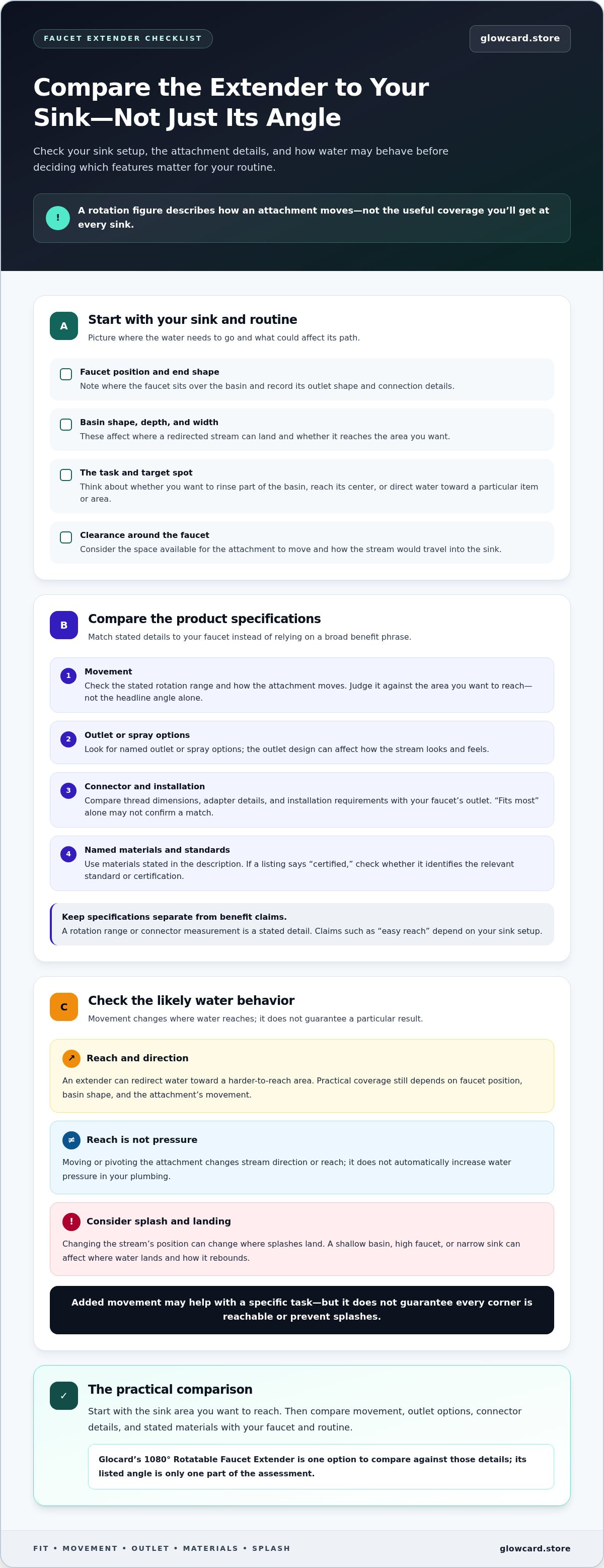
A Simple Pre-Purchase Check for a Rotatable Faucet Extender
A few notes about your faucet can make product information easier to assess. You don’t need to take anything apart. Record visible details, compare them with the stated specifications, and decide whether the attachment suits the way you use the sink.
- Inspect the faucet end. Note whether it appears to have a removable end fitting and describe its visible shape. Check where the outlet sits over the basin and whether nearby surfaces or fixtures limit space.
- Record the connection details you can identify. Write down visible markings or measurements you can access without disassembling the faucet. Don’t infer a thread type or compatibility from appearance alone. Similar-looking ends don’t necessarily have matching connections.
- Compare the product specifications. Look at connector dimensions, adapter details, attachment dimensions, and stated compatibility notes. Compare these with your notes and available clearance, and use the specified measurements rather than relying on a general “universal fit” claim.
- Assess your sink routine. Identify the task you want to make easier, such as reaching a particular part of the basin. Compare the product’s stated movement and dimensions with your faucet position and the space around it.
What should you note about your current faucet?
Start with what’s visible. Is there a distinct end fitting, and does it appear to sit inside or outside the faucet outlet? Record its shape and any accessible measurements, then note the gap between the outlet and nearby surfaces. Also observe whether the faucet is centered over the basin or closer to one side.
These observations help with comparison, but they don’t identify a connector standard by themselves. Avoid guessing based on a photo or general resemblance. Keep your notes factual so you can compare them with the exact dimensions and connection information for an attachment.
How do you match your notes to a product listing?
Compare like with like: faucet-end details against connector details, and available space against the attachment’s stated dimensions. Review the compatibility notes and intended use, then compare them with your measurements and sink routine. A useful match should make sense on paper before you decide how the attachment would fit into everyday use.
Use this checklist to evaluate Glocard’s 1080° Rotatable Faucet Extender. Compare the product information with your faucet notes and sink needs to decide whether it suits your setup.
Explore Glocard’s 1080° Rotatable Faucet Extender
Glocard offers the 1080° Rotatable Faucet Extender - Splash-Free Kitchen & Bathroom Upgrade. Its name identifies it as a 1080° rotatable faucet extender and presents it for kitchen and bathroom use. The “splash-free” wording is part of the product name, not a guarantee that splashing will be prevented in every sink or setup.
Apply the same practical checks you’d use for any faucet attachment. The angle in the name is one detail, not a complete picture of how the extender will work with your basin. Compare the product information with your faucet and the tasks you have in mind before deciding.
What is the Glocard faucet extender called?
The exact name is 1080° Rotatable Faucet Extender - Splash-Free Kitchen & Bathroom Upgrade. Keep the full name in mind as you review the option, but don’t read “1080°” as proof of how much of your particular basin the water will reach. Likewise, “splash-free” doesn’t guarantee a specific result. Your faucet position, sink shape, and routine still matter.
Focus on product details that support a direct comparison, such as dimensions, connector information, compatibility notes, materials, and outlet details. Match them with the notes and measurements you gathered for your faucet. Assess the stated information on its own rather than assuming that features of other extenders apply here.
Then consider the intended use alongside your routine. The product name mentions both kitchen and bathroom use, but your faucet and basin determine whether the attachment suits your setup. Think about fit and clearance in the particular sink where you plan to use it.
What can shoppers expect from the Glocard storefront?
Glocard’s storefront advertises fast shipping, secure payment, and easy returns. These are shopping details, separate from the extender’s product specifications. Consider both the sink-related information and the storefront details, without treating either as a substitute for the other.
If the product suits your needs, explore the 1080° Rotatable Faucet Extender - Splash-Free Kitchen & Bathroom Upgrade and review its product information. A considered choice starts with how the attachment fits your faucet and routine, not with a headline claim alone.
Make Your Next Sink Upgrade a Considered One
A useful sink accessory should suit the way you use your space, not just sound impressive on a product page. If you’re weighing whether a rotatable faucet extender belongs in your routine, compare the product information with your faucet and the tasks you want to make easier.
Glocard’s 1080° Rotatable Faucet Extender - Splash-Free Kitchen & Bathroom Upgrade is an option to explore. Its name states the rotation figure, while the product information can help you assess the details relevant to your setup. Glocard’s storefront also advertises fast shipping, secure payment, and easy returns.
Explore Glocard’s 1080° Rotatable Faucet Extender and decide whether it suits your sink, space, and expectations. Start with your faucet’s connection and the area you want the water to reach.
Frequently Asked Questions
Will a rotatable faucet extender fit every faucet?
No. Fit depends on the faucet-end connection, dimensions, and the extender’s stated compatibility. For example, a faucet with a recessed or unusually shaped outlet may not match an attachment designed for a different connection. Compare the product details with your faucet’s measurements, and don’t treat a similar appearance as proof of fit.
Can a faucet extender improve low water pressure?
No. An extender redirects the stream; it shouldn’t be expected to increase pressure in your home’s plumbing. The stream may feel different after adding an attachment, depending on its design and the faucet, but that isn’t the same as correcting low pressure. If several taps have weak flow, or the change is sudden, consider the faucet or plumbing separately rather than relying on an extender to solve it.
Does a rotatable faucet extender prevent splashing?
Not in every sink. Splashing can depend on how forcefully water flows, the height of the faucet, the basin’s shape, and where the stream hits. Directing water toward a different spot may suit your setup, but a product name or promotional phrase can’t guarantee a splash-free result. A shallow basin may respond differently from a deep one, so keep expectations tied to your own sink.
Can I use a faucet extender with a pull-down or pull-out faucet?
Possibly, but the faucet category alone doesn’t establish compatibility. A pull-down or pull-out model may have a shaped spray head or moving parts that affect the connection and available clearance. Compare the faucet’s outlet configuration with the attachment’s connector details. Also consider whether an added fitting would interfere with the spray head’s movement or how you return it to its holder.
How do I clean a rotatable faucet extender?
Follow the care guidance for the specific attachment, since cleaning methods can vary by material and design. Don’t assume a cleaner, soaking method, or disassembly approach is suitable without instructions. For routine surface care, a gentle wipe may be a sensible starting point if the product guidance allows it. If the stream changes or buildup appears near the outlet, consult the product instructions before removing parts.
Will a faucet extender fit a small bathroom sink?
It can if the faucet connection and available space suit the attachment, but compact sinks leave less room for added length or height. Picture your usual handwashing position and consider whether the extender could crowd the basin or nearby fixtures. For example, a faucet close to a mirror shelf may have limited overhead clearance. Compare the attachment’s stated dimensions with the space available, not just the basin’s width.

